
Treatments
Crowns & Bridges in Alsager
If a tooth is too damaged for a filling, or you’ve lost a tooth, a crown or bridge may help. We’ll explain your options, including any alternatives, so that you can choose what’s right for you.
We’ll talk you through what’s involved, show you what we can see on our big screen and give you an itemised quote before any treatment starts.
Your options
Crowns, bridges and onlays
Each one is made for you by our dental lab. We’ll explain which suits your tooth, including any alternatives, so that you can choose what’s right for you.
 Protect a tooth
Crowns
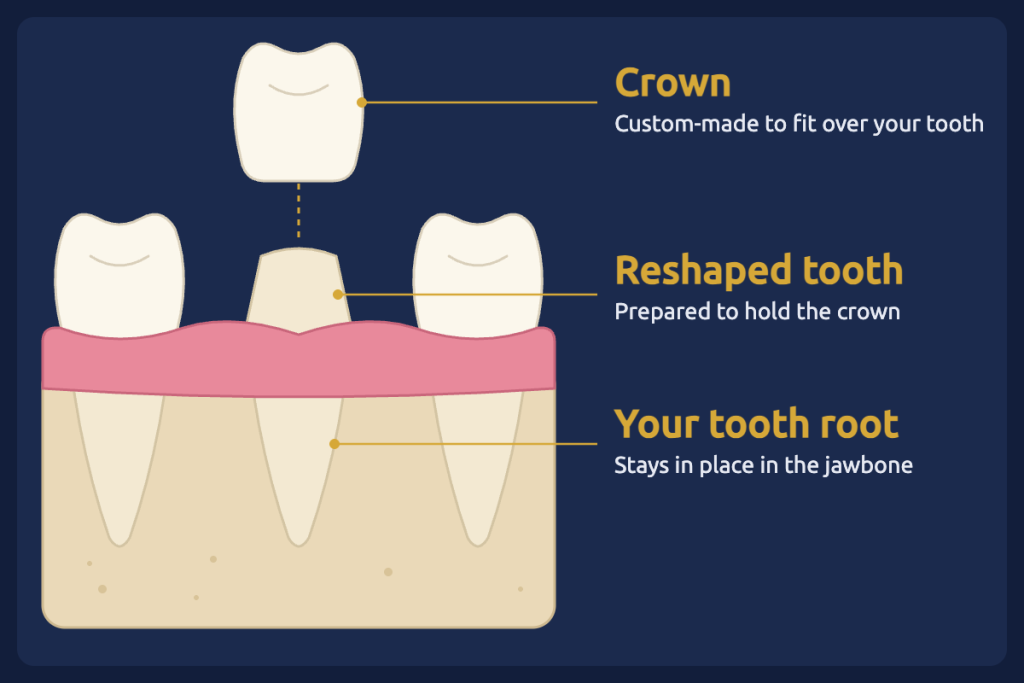
A crown is a custom-made cap that fits over a weakened tooth. It helps to protect it and improve how it looks, and we match it to your other teeth as closely as we can. A crown may be recommended if a tooth is:
- Cracked, broken or badly worn
- Heavily filled, with little natural tooth left
- Discoloured or a poor shape
- Weakened after root canal treatment
 Replace a tooth
Bridges
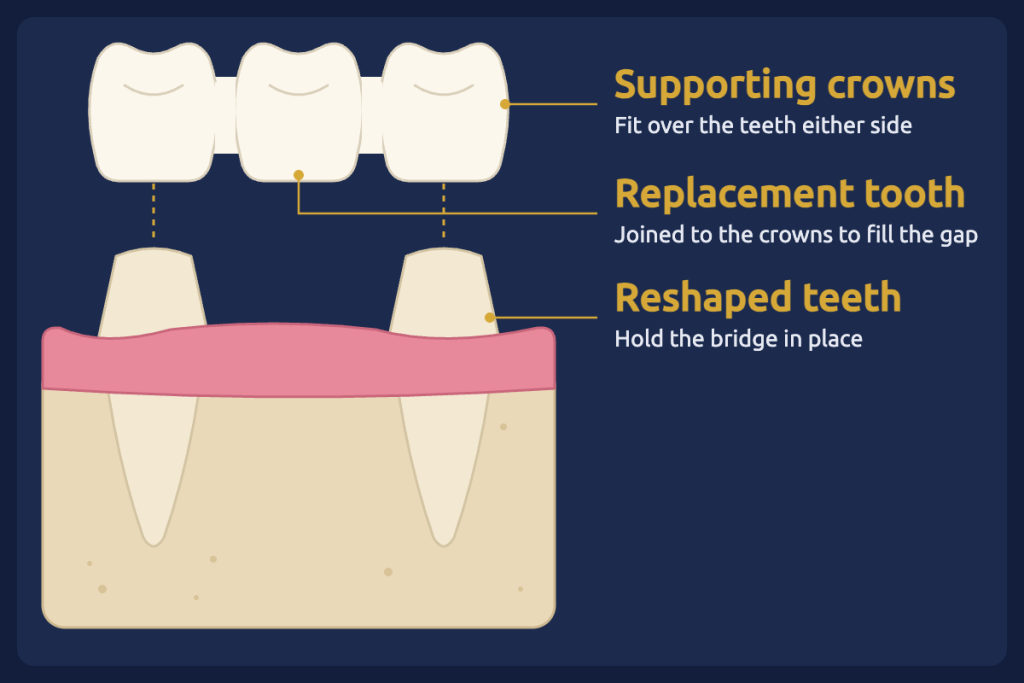
A bridge replaces one or more missing teeth by attaching to the teeth next to the gap. It’s fixed in place, so you don’t take it out.
- Can be supported by dental implants if several teeth in a row are missing
- Pink porcelain can be added to help it blend in if your gums have receded
- A denture or implant may be an alternative, and we’ll talk through the pros and cons of each
 Repair part of a tooth
Onlays
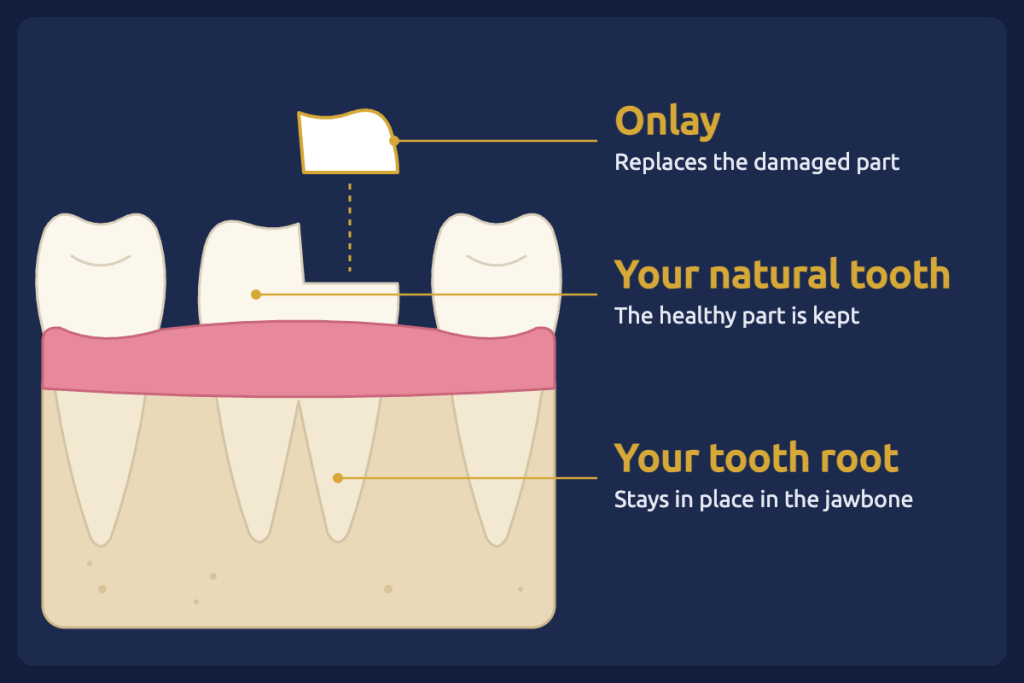
An onlay replaces just the damaged part of a tooth, often one or more of its biting corners. It’s made to fit, then fixed to your tooth.
- Keeps more of your natural tooth than a crown
- Can suit a broken corner that’s too big for a filling
- Can be stronger than a large filling, helping to support what’s left
An onlay isn’t right for every tooth. If the damage is more extensive, a crown may still be the better option.
How it works
What happens during treatment
Here’s what to expect, from your first visit to your fitting.
1
Consultation
We examine the tooth, take any x-rays needed and explain your options.
2
Preparing the tooth
Under local anaesthetic, we reshape the tooth to make room for your crown or bridge.
3
Your temporary
We usually take an impression to make a temporary crown, which protects your tooth in the meantime.
4
3D scan
Our iTero scanner takes an accurate 3D scan, which goes to our trusted dental lab with detailed instructions.
5
Fitting
Once it’s made, we check the fit, bite and appearance, then fix it in place.
Want to see what’s involved? Watch our crown preparation video on Instagram.
Materials and prices
Choosing the right material
We’ll help you choose the right material for your tooth, your bite and how you’d like it to look.
White crown£870Porcelain, Emax or zirconia, for a natural look
High aesthetic white crown£1,074Layered Emax or zirconia, for the most visible teeth
Metal crown£870A strong option that’s often used for back teeth
Gold crown£1,194A strong option that’s often used for back teeth
Bridges are priced per unit. For example, one missing tooth and one supporting tooth is 2 x the crown price. Onlays are the same fee as a crown. You’ll get an itemised quote before treatment starts. See all our fees and finance options.
Spread the cost with finance at 0% APR over 3, 6, 10 or 12 months, subject to status. See the representative example.
Good to know
Risks and looking after them
Preparing a tooth removes some of its structure, and it may become sensitive. Occasionally, a prepared tooth may need root canal treatment.
Crowns and bridges can chip or come loose, and the tooth underneath can still decay. We’ll go through all of this with you before you decide.
To help yours last
- Brush twice a day
- Clean between your teeth, and under your bridge, as we show you
- Keep up your regular check-ups
- Book regular hygiene appointments
Questions
Crowns & bridges FAQs
Can’t see your question? Give us a call on 01270 876026 and we’ll be happy to help.
Will it hurt?
We use local anaesthetic, so the tooth is numb while we work. It may feel a little tender afterwards, and some people have short-term sensitivity. If you’re nervous, please tell us and we’ll go at your pace.
How long does a crown or bridge last?
It varies from person to person, but with good care a crown or bridge can last many years. How long yours lasts depends on things like your bite, whether you grind your teeth and how well you keep the area clean.
Should I have a bridge or an implant?
It depends on your teeth, your gums, the bone in your jaw and what matters most to you. A bridge relies on neighbouring teeth, while an implant is placed in the jawbone. We’ll explain the options that suit you.
Can I whiten a crown?
No, crowns and bridges don’t change colour with whitening. If you’re thinking about whitening your teeth, it’s best to do this first, so that we can match your new crown to your whiter teeth.
What if my crown comes off?
Keep the crown if you can, and call us on 01270 876026. See our emergency page for what to do when we’re closed.
Book your visit
Ready to talk through your options?
Call us on 01270 876026 or send us a message and we’ll get back to you.